Australian First Nations organisation named in OECD global report highlighting adult literacy success
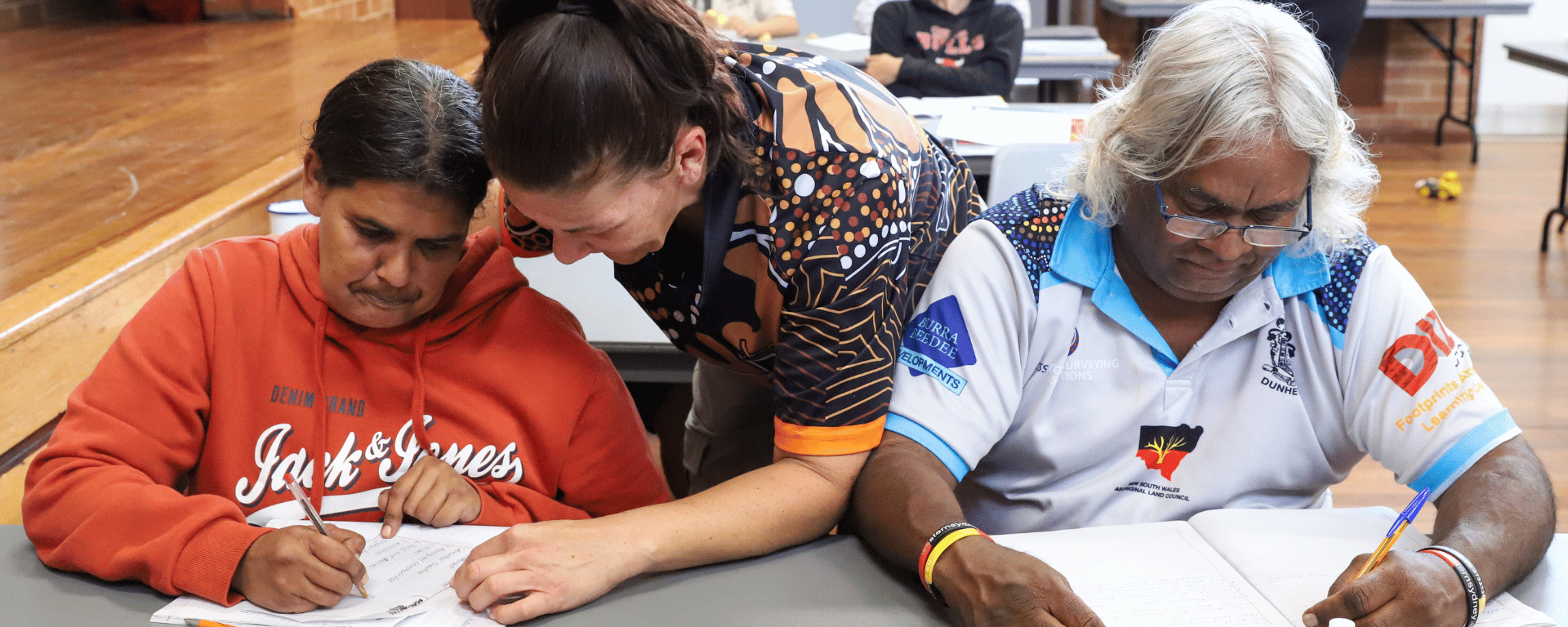
Literacy for Life's Sara (centre) supporting students Bronwyn (left) and Cedric (right) in the classroom.
OECD highlights success of Australian First Nations literacy organisation
The Organisation for Economic Co-operation and Development (OECD) has praised the community-led approach of Australian First Nations organisation, Literacy for Life Foundation, in a global report on adult literacy and numeracy.
The report, titled Navigating Life with Low Literacy and Numeracy, was released earlier this month and collates international data from 31 countries, finding that one in three people across OECD economies lack the foundational skills to participate effectively in the labour market and society.
“This share has grown over the past decade, making low foundational skills one of the most persistent structural challenges facing advanced economies,” the report states.
Even though Australia did not provide data for the report, having previously withdrawn from the international survey the findings are drawn from (see additional notes below), the authors singled out First Nations organisation, Literacy for Life Foundation, for its world-leading community-led approach.
“Australia’s Literacy for Life campaign illustrates how community-embedded delivery, built around trusted local facilitators and cultural relevance, can reach populations with very low literacy who are consistently underserved by mainstream provision,” the report states.
Literacy for Life Foundation’s Executive Director, Ngemba man Professor Jack Beetson, says he is glad the international community is taking notice.
“In First Nations communities low English language literacy is impacting all aspects of life. The ongoing failures of the education system mean at least half of our people struggle with reading and writing and in some communities that number is as high as 90 per cent,” says Professor Beetson.
“The good news is we have the evidence to turn things around and the OECD has now recognised Literacy for Life Foundation’s approach as globally significant. It is a huge endorsement for what First Nations communities have known for decades, that our people are best placed to lead their own education,” says Beetson.
Literacy for Life Foundation was set up in 2013 to develop an Aboriginal community-controlled approach to lift adult English language literacy levels in First Nations communities, aiming to replicate the success of the Aboriginal community-controlled health sector.
With funding from the Australian and NSW Governments, as well as donations from the public, the Literacy for Life Foundation now operates in nine First Nations communities, utilising an innovative model that supports local people to lead learning that works for them.
In directing policymakers to Literacy for Life Foundation as an example of success, the OECD report states the following:
A defining feature of the programme is its locally embedded delivery model. Rather than relying on formal education institutions, Literacy for Life is implemented through locally recruited and trained facilitators, with learning taking place in small, group-based sessions within community settings. This approach is designed to build trust, ensure cultural relevance, and reduce barriers related to stigma and prior negative experiences with formal education. Community leaders play a central role in outreach and delivery, helping to engage adults who are typically underrepresented in adult learning.
Available evidence indicates positive outcomes for participants. The programme has supported more than 500 adults nationwide to become functionally literate. Completion rates are reported at around 59%, which is higher than those typically observed in other mainstream adult literacy provision for Indigenous adults. Participants also report increased confidence, greater willingness to engage in further education and training, and stronger participation in community and civic life.
Professor Beetson hopes the findings of the report reinforce the need for governments to let go of discredited ways of working that disempower First Nations communities.
“Tackling low literacy requires brave and urgent action by governments and bureaucrats because it can’t work the old way. Nothing will improve until we have more of our people reading and writing and for that to happen Literacy for Life’s work needs to be replicated at scale, with community calling the shots,” says Professor Beetson.
The OECD report is available online and also available as a downloadable PDF:
https://www.oecd.org/en/publications/navigating-life-with-low-literacy-and-numeracy_c198a20f-en/full-report.html
Note regarding data: The report, Navigating Life with Low Literacy and Numeracy, draws on data collected in the last completed round (2023) of the Survey of Adult Skills, the OECD Programme for the International Assessment of Adult Competencies (PIAAC), which Australia did not participate in, due to the Morrison Government having withdrawn from the process. The Albanese Government has rejoined the process and is developing other national adult literacy data projects in the meantime. Literacy for Life Foundation continues to call for urgent action that genuinely acknowledges the scale of the issue in First Nations communities and commits to an appropriate and funded policy response.